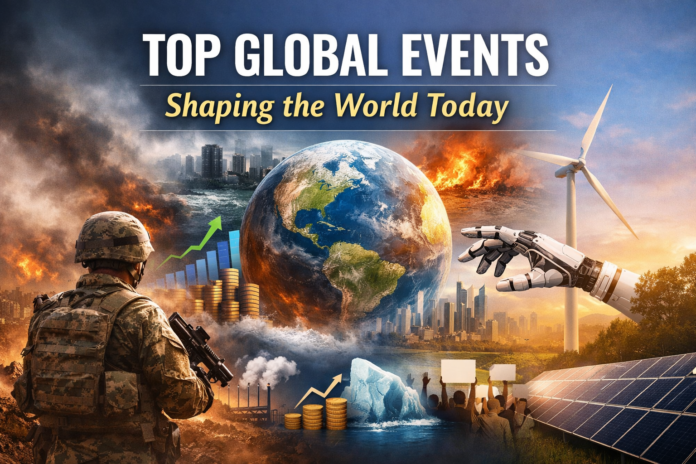
The world is changing faster than at any other point in modern history. Political shifts, economic realignments, technological breakthroughs, and climate challenges are no longer isolated developments—they are interconnected forces reshaping how nations operate and how people live.
Understanding the top global events shaping the world today is essential not just for policymakers and analysts, but for everyday citizens, businesses, and communities. These events influence everything from food prices and job markets to security, digital freedom, and the future of our planet.
Below is a comprehensive look at the most influential global developments defining the present—and shaping what comes next.
1. Geopolitical Tensions and Shifting Power Dynamics
One of the most defining global trends today is the rebalancing of geopolitical power. Traditional alliances are being tested, while emerging nations are asserting greater influence on the world stage.
Ongoing conflicts, regional disputes, and strategic rivalries have reshaped diplomacy and global security. Countries are rethinking defense strategies, strengthening military alliances, and increasing defense budgets in response to growing uncertainty.
At the same time, international institutions are under pressure to adapt to a multipolar world where a handful of nations no longer dominate or influence. This shift is redefining how global decisions are made—and who gets to make them.
2. Global Economic Uncertainty and Inflation Pressures
The global economy is navigating one of its most complex periods in decades. Inflation, rising interest rates, supply chain disruptions, and uneven recovery have created uncertainty for both developed and developing nations.
Key economic events shaping the world today include:
- Persistent inflation is impacting household spending.
- Central banks are tightening monetary policy.
- Slower global growth projections
- Increased debt burdens in emerging economies
These economic challenges affect employment, housing markets, trade relations, and long-term investment decisions. Businesses and consumers alike are being forced to adapt to a new financial reality.
3. Climate Change and Extreme Weather Events
Climate change is no longer a future concern—it is a present-day global crisis. Rising temperatures, melting ice caps, and increasingly frequent extreme weather events are reshaping ecosystems and economies worldwide.
Floods, heatwaves, droughts, and wildfires are affecting food security, displacing populations, and straining infrastructure. Governments are facing growing pressure to balance economic development with environmental responsibility.
Global climate agreements and sustainability initiatives are expanding, but implementation remains uneven. How the world responds to climate change today will define living conditions for generations to come.
4. Rapid Advancements in Artificial Intelligence and Technology
Technological innovation—particularly in artificial intelligence (AI)—is transforming nearly every industry. From healthcare and education to finance and media, AI is redefining productivity, creativity, and decision-making.
However, this rapid progress also raises critical questions:
- How will jobs evolve in an AI-driven economy?
- Who regulates powerful technologies?
- How do we protect privacy and data rights?
The race for technological leadership is now a key factor in global competition, influencing economic power and national security alike.
5. Energy Transition and the Future of Global Power Supply
Energy has become a central issue in global affairs. Nations are working to reduce reliance on fossil fuels while ensuring affordable and reliable energy access.
Major developments shaping the energy landscape include:
- Expansion of renewable energy sources
- Investments in electric vehicles and battery technology
- Debates over nuclear energy
- Competition over critical minerals
The transition to clean energy is not just an environmental goal—it is a geopolitical and economic one that will shape global influence and industrial leadership.
6. Public Health Challenges Beyond the Pandemic
While the immediate crisis of global pandemics has eased, public health remains a defining global issue. Healthcare systems are addressing long-term impacts, mental health challenges, and preparedness for future outbreaks.
Global cooperation in health research, vaccine distribution, and disease surveillance has improved, but inequalities persist. Access to quality healthcare remains deeply uneven across regions, influencing life expectancy and economic stability.
7. Social Movements and the Fight for Equality
Social and cultural movements are reshaping societies worldwide. Issues related to human rights, gender equality, racial justice, and freedom of expression are gaining momentum across borders.
Digital platforms have amplified voices that were once marginalized, leading to greater accountability—but also increased polarization. Governments and institutions are being challenged to respond to public demands for transparency, inclusion, and reform.
These movements are not isolated events; they are redefining social contracts and governance models globally.
8. Digital Information, Misinformation, and Media Influence
The way information spreads today has a profound impact on global events. Social media, digital journalism, and instant communication shape public opinion faster than ever before.
However, misinformation and disinformation campaigns pose serious risks to democracy, public trust, and international stability. Countries are grappling with how to regulate digital spaces without undermining free speech.
The battle over information has become a critical front in global influence and power.
Why These Global Events Matter More Than Ever
The most important thing to understand about today’s global events is how deeply interconnected they are. Economic instability affects political decisions. Climate change drives migration. Technology reshapes power structures.
Ignoring these connections makes it harder to prepare for what lies ahead—whether you are a business owner, student, policymaker, or global citizen.
Final Thoughts: A World in Transformation
The top global events shaping the world today are not isolated headlines—they are signals of long-term transformation. The choices nations and individuals make now will determine economic resilience, environmental sustainability, and social stability in the years ahead.
Staying informed is no longer optional. It is essential for navigating an increasingly complex and rapidly changing world.