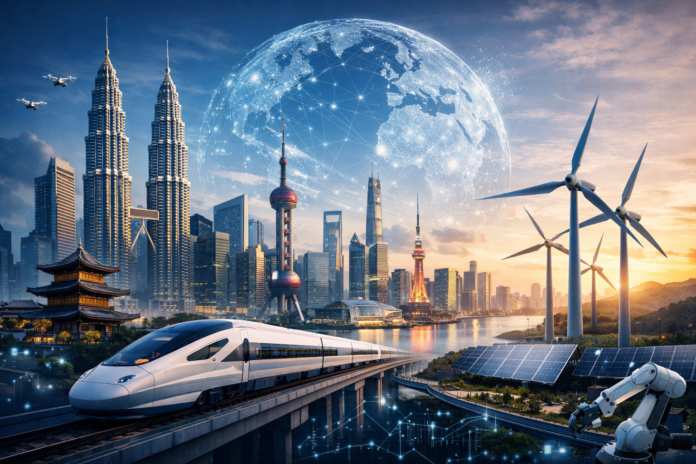
For centuries, the global narrative was shaped primarily by the West. Economic models, political ideas, technological breakthroughs, and cultural influence flowed outward from Europe and North America. Today, that story is changing—fast.
Asia is no longer “catching up.” It is setting the pace.
From artificial intelligence labs in China to semiconductor powerhouses in Taiwan, green energy revolutions in India, and cultural exports from South Korea and Japan, Asia is redefining how the future looks, works, and feels. This transformation is not theoretical. It is already unfolding, reshaping global economics, innovation, geopolitics, and everyday life.
This is how Asia is redefining the future of the world—and why the rest of the planet is paying close attention.
Asia’s Economic Gravity Is Reshaping Global Power
Asia has become the center of global economic momentum.
More than half of the world’s economic growth now comes from Asian countries. China and India alone represent nearly three billion people, with expanding middle classes that are transforming consumption, labor markets, and global trade patterns.
Unlike older industrial economies, many Asian nations skipped entire development stages. Instead of moving from landlines to desktops to smartphones, they jumped straight into mobile-first economies. This leapfrogging has produced faster innovation, lower costs, and entirely new business models.
Key shifts include:
- Manufacturing dominance evolving into high-value production
- Export-driven economies transforming into consumer-led markets
- Regional trade agreements strengthening intra-Asian supply chains
Asia is no longer dependent on Western demand—it is increasingly self-sustaining, interconnected, and influential.
Technology Innovation Is No Longer West-Centric
When people think of innovation, Silicon Valley still comes to mind. But today, some of the most ambitious technological advancements are happening across Asia.
Artificial Intelligence and Automation
Asian countries are investing heavily in AI for healthcare, transportation, finance, and governance. AI-powered cities, biometric payments, and predictive public services are becoming real-world experiments at a national scale.
Semiconductors and Hardware Leadership
Taiwan and South Korea dominate the semiconductor industry—the backbone of modern technology. Without Asia, there is no global digital economy.
Fintech and Digital Payments
Cashless societies are already a reality in parts of Asia. Mobile wallets, QR payments, and super-app ecosystems have redefined how billions of people bank, shop, and invest.
Asia isn’t just adopting technology—it is designing systems for scale, often serving populations larger than entire continents.
Asia’s Cultural Influence Is Going Global
Power today is not only economic or technological. It is cultural.
Asian culture now shapes global entertainment, fashion, food, and social trends at a scale never seen before.
- Korean pop culture dominates music charts and streaming platforms worldwide.
- Japanese design influences gaming, animation, and consumer products.
- Asian cuisine has become mainstream rather than niche.
- Storytelling from Asia is redefining global cinema and television.
This cultural expansion reflects something deeper: Asia is telling its own stories, on its own terms, and the world is listening.
A New Model of Urbanization and Smart Cities
Asia is home to some of the world’s largest, fastest-growing cities. But instead of repeating the mistakes of older industrial cities, many Asian urban centers are becoming living laboratories for the future.
Smart infrastructure, high-speed rail, digital governance, and integrated public services are redefining how cities function.
These cities emphasize:
- Density without chaos
- Public transportation over car dependency
- Digital access to essential services
- Data-driven urban planning
The result is a blueprint for sustainable urban living that other regions are now studying—and copying.
Asia’s Approach to Sustainability Is Pragmatic, Not Theoretical
Climate change will define the next century, and Asia sits at the center of both the challenge and the solution.
As the world’s largest energy consumer, Asia also leads in renewable energy investment, green manufacturing, and climate adaptation technologies.
What sets Asia apart is scale and urgency. Solar farms, electric vehicles, battery storage, and smart grids are being deployed at speeds unmatched elsewhere.
Rather than framing sustainability as a luxury, many Asian countries treat it as an economic necessity—a survival strategy that also creates jobs, innovation, and global leadership.
A Different Philosophy of Growth and Governance
One of the most overlooked ways Asia is redefining the future lies in its philosophical approach to progress.
Many Asian societies emphasize:
- Long-term planning over short-term gains
- Collective benefit alongside individual success
- Stability as a foundation for innovation
This doesn’t mean one model fits all. Asia is diverse, complex, and often contradictory. But the region offers alternative frameworks for development that challenge the idea that there is only one path to modernity.
The future is becoming multipolar—economically, politically, and intellectually.
Why Asia’s Rise Matters to the Entire World
Asia’s transformation is not happening in isolation. It affects global supply chains, labor markets, innovation cycles, geopolitics, and cultural norms.
What happens in Asia increasingly determines:
- The cost of technology worldwide
- The direction of global climate efforts
- The evolution of digital society
- The balance of global power
Understanding Asia is no longer optional—it is essential.
The Future Is Being Built in Asia—In Real Time
The question is no longer whether Asia will shape the future.
It already is.
The laboratories of innovation, the engines of growth, and the cultural narratives defining the 21st century are increasingly Asian. The rest of the world is not watching from a distance—it is participating, adapting, and responding.
Asia is not replacing the world’s future.
It is redefining it.
Final Thought
Those who recognize Asia’s role early will understand the future more clearly. Those who ignore it will struggle to keep up.
Because the future isn’t coming from one place anymore.
It’s rising—powerfully, creatively, and decisively—from Asia.