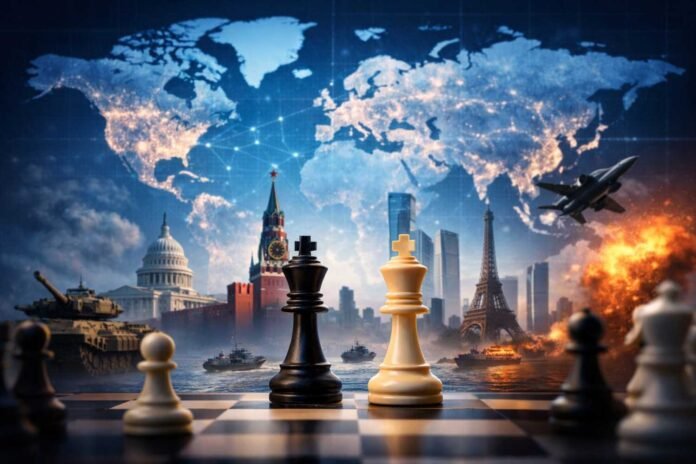
Global politics is undergoing one of its most profound transformations since the end of the Cold War. Power is no longer concentrated in a single dominant bloc, long-standing alliances are under pressure, and emerging nations are reshaping the rules of international engagement. To understand today’s world—and where it may be headed—it’s essential to examine the current state of global politics through a clear, balanced lens.
This article explains the forces shaping global political dynamics, from geopolitical rivalries and economic fragmentation to climate diplomacy and technological competition.
A World Moving Away From Unipolar Power
For much of the late 20th and early 21st centuries, global politics was largely defined by a U.S.-led international order. That era is fading. Today’s political landscape is increasingly multipolar, with power distributed among several major actors. The United States remains influential but faces internal polarization and external competition. China continues its rise as a strategic, economic, and technological power. Russia asserts itself through military and energy influence. The European Union seeks unity while managing internal divisions. Regional powers such as India, Brazil, Turkey, and Saudi Arabia are gaining leverage.
This shift has created a more complex global system—one where cooperation is harder to sustain, and conflict is more difficult to contain.
Geopolitical Tensions and Ongoing Conflicts
One of the defining features of the current state of global politics is persistent geopolitical tension. Several regions continue to shape global stability. Eastern Europe remains volatile due to prolonged military conflict and NATO–Russia tensions. The Middle East faces overlapping crises involving state rivalries, proxy conflicts, and humanitarian emergencies. The Indo-Pacific has become a strategic hotspot, with growing competition over trade routes, security, and regional influence.
These conflicts do not exist in isolation. They affect global energy markets, food security, migration patterns, and diplomatic relations worldwide.
The Fragmentation of the Global Economy
Economic interdependence once served as a stabilizing force in global politics. Today, that assumption is being challenged. Trade decoupling—particularly between major economies—has accelerated. Sanctions and economic pressure are increasingly used as political tools. Many countries are shifting toward regional supply chains and economic security strategies.
Globalization is not ending, but it is evolving into a more fragmented and strategic system where political alignment increasingly determines economic partnerships.
The Role of Climate Change in Global Politics
Climate change is no longer just an environmental issue. It is a central political concern. Governments are grappling with climate-driven migration, resource scarcity, and disagreements over emissions responsibility. Competition over green technologies and critical minerals has intensified.
Climate diplomacy has become a test of global cooperation, revealing deep divides between developed and developing nations over funding, accountability, and timelines.
Technology, Information, and Power
Another defining element of today’s global politics is the battle over technology and information. Countries are competing for leadership in artificial intelligence, cybersecurity, and digital infrastructure. At the same time, misinformation and digital propaganda are reshaping elections, public trust, and international relations.
Political power now extends beyond borders through screens, platforms, and algorithms.
The Crisis of Global Governance
International institutions created after World War II are struggling to adapt to modern realities. Limited enforcement power, veto-driven gridlock, and declining trust in multilateral solutions have weakened global governance. As a result, many countries are turning to bilateral agreements, regional alliances, or unilateral action, further complicating coordination on global challenges.
What the Current State of Global Politics Means for the Future
The current state of global politics is defined more by uncertainty than stability. Cooperation still exists, but it is increasingly selective and strategic. Conflict is not inevitable, yet miscalculation is more likely in a fragmented world.
Key questions moving forward include whether major powers can manage competition without escalation, whether emerging nations will reshape global rules, and whether shared challenges like climate change and pandemics can restore meaningful cooperation.
Final Thoughts
Understanding the current state of global politics requires moving beyond headlines and recognizing the interconnected forces at play. Power shifts, economic realignments, technological rivalry, and environmental pressures are reshaping how nations interact.
In a world where certainty is rare and change is constant, informed analysis matters more than ever. The global political landscape may be unstable, but it still offers opportunities for cooperation, reform, and progress.