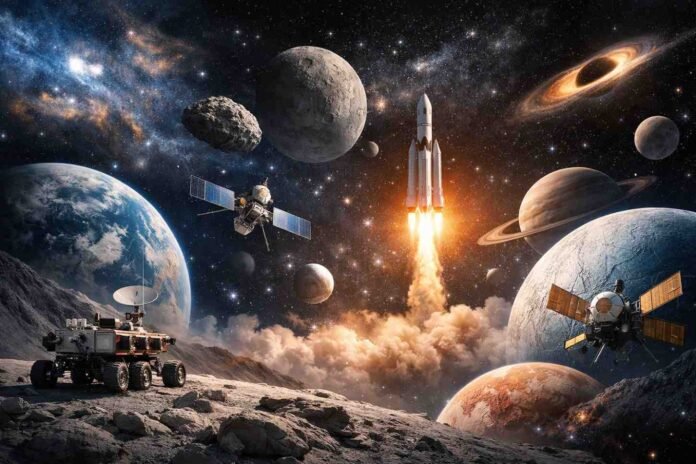
Space science is entering one of its most exciting eras in human history. With cutting-edge missions launching almost every year and discoveries reshaping what we know about the universe, our understanding of space is evolving faster than ever before. From probing distant exoplanets to uncovering secrets hidden beneath icy moons, modern space science is not just about exploration—it’s about redefining humanity’s place in the cosmos.
In this article, we break down new space missions and groundbreaking discoveries in a clear, engaging way, making complex science accessible without oversimplifying it.
Why Space Science Matters More Than Ever
Space science is no longer a niche field reserved for astronomers and astrophysicists. Today, it directly impacts:
- Climate monitoring and Earth protection
- Global communication and navigation
- Technological innovation
- The search for extraterrestrial life
Every new mission contributes data that helps us protect our planet, improve daily life, and expand human knowledge beyond Earth’s boundaries.
Major New Space Missions Changing Our Understanding of the Universe
1. Deep Space Observatories: Seeing the Universe in New Light
Modern space telescopes are doing far more than capturing beautiful images. They are analyzing atmospheric chemistry, measuring cosmic expansion, and looking back billions of years in time.
New-generation observatories can:
- Detect faint galaxies formed shortly after the Big Bang.
- Analyze exoplanet atmospheres for water vapor and organic molecules.
- Study star formation in unprecedented detail
These missions are helping scientists answer age-old questions about how galaxies form and whether life exists elsewhere.
2. Planetary Exploration Missions: Beyond Mars
While Mars continues to dominate headlines, space agencies are expanding their focus:
- Venus missions aim to understand why a once Earth-like planet became uninhabitable.
- Jupiter and Saturn’s moon missions investigate subsurface oceans beneath icy crusts.
- Asteroid missions collect samples that preserve the earliest materials from the solar system.
These explorations are reshaping theories about planetary evolution and the origins of water and life.
3. Lunar Missions: Preparing for a Permanent Human Presence
The Moon is once again a priority in space science. Modern lunar missions focus on:
- Mapping water ice in permanently shadowed craters
- Testing technologies for long-term human habitation
- Using the Moon as a gateway for deeper space exploration
Unlike past missions, today’s lunar exploration emphasizes sustainability and long-term infrastructure.
Recent Space Discoveries That Are Redefining Science
Water in Unexpected Places
One of the most important discoveries in recent space science is the widespread presence of water:
- Beneath icy moons
- Trapped in lunar soil
- Within ancient asteroid samples
This supports the idea that water—and possibly life—may be far more common in the universe than once believed.
Organic Molecules Beyond Earth
Space missions have detected complex organic compounds on comets, asteroids, and planetary surfaces. While these molecules do not confirm life, they are the building blocks necessary for it.
This strengthens the theory that life’s ingredients may form naturally across the cosmos.
Gravitational Waves and Cosmic Collisions
Space-based detectors are now observing ripples in spacetime caused by massive cosmic events like black hole mergers. These observations provide insights into phenomena that were previously invisible to traditional telescopes.
This entirely new way of observing the universe has opened a fresh chapter in astrophysics.
The Role of Artificial Intelligence in Modern Space Science
AI is transforming space exploration behind the scenes. It helps scientists:
- Analyze massive datasets from telescopes.
- Identify patterns humans might miss.
- Navigate spacecraft autonomously
- Predict system failures before they occur.
Rather than replacing scientists, AI acts as a powerful research partner, accelerating discoveries.
How Space Science Benefits Life on Earth
Many technologies we rely on daily began as space science innovations, including:
- Satellite-based weather forecasting
- GPS navigation
- Medical imaging techniques
- Advanced materials and insulation
Space research continues to drive progress in healthcare, communication, and environmental science.
The Future of Space Science: What Comes Next?
Looking ahead, space science will focus on:
- Human missions beyond low Earth orbit
- Advanced telescopes capable of imaging Earth-like exoplanets
- Robotic explorers in extreme environments
- International collaboration on deep-space projects
The next decade promises discoveries that could fundamentally change how we understand life, matter, and the universe itself.
Final Thoughts
Space science is no longer just about exploration—it’s about connection. Each new mission and discovery links humanity more deeply to the universe we inhabit. As technology advances and collaboration grows, the boundaries of knowledge will continue to expand.
Understanding space science, new missions, and discoveries isn’t just for scientists—it’s for anyone curious about where we came from and where we might be going.
The universe is still full of mysteries, and we’ve only just begun to uncover them.