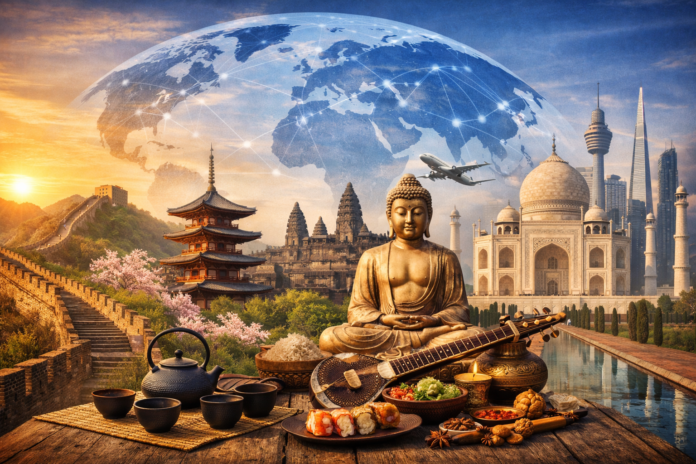
Asia is not just the world’s largest continent by landmass—it is the spiritual, intellectual, and cultural backbone of human civilization. From ancient philosophies that shape modern ethics to artistic traditions that inspire global fashion, cuisine, architecture, and technology, Asia’s cultural heritage continues to influence the world in profound and lasting ways.
This heritage is not frozen in the past. It evolves, adapts, and travels—crossing borders and generations while remaining rooted in centuries-old traditions. Understanding Asia’s cultural heritage is, in many ways, understanding the foundations of global culture itself.
The Depth and Diversity of Asia’s Cultural Heritage
Asia is home to thousands of ethnic groups, languages, belief systems, and artistic traditions. Unlike monolithic cultural narratives, Asian heritage is deeply pluralistic—shaped by geography, climate, religion, and historical exchange.
Ancient Civilizations That Shaped Humanity
Some of the world’s earliest and most influential civilizations emerged in Asia:
- The Indus Valley Civilization (South Asia) introduced urban planning and sanitation systems still admired today.
- Ancient China gave rise to Confucianism, Taoism, papermaking, printing, and early scientific thought.
- Mesopotamian cultures in West Asia laid the foundations for law, astronomy, and governance.
- Ancient Persia influenced administration, architecture, and diplomacy across continents.
These civilizations did more than flourish locally—they shaped political systems, philosophies, and technologies that spread far beyond Asia
Philosophies and Belief Systems with Global Reach
One of Asia’s most enduring contributions is its philosophical and spiritual traditions, many of which continue to influence global thought.
Eastern Philosophies in Modern Life
- Buddhism, originating in South Asia, now shapes mindfulness practices, psychology, and wellness movements worldwide.
- Hindu philosophy has influenced yoga, meditation, and holistic health systems practiced across the globe.
- Confucian values of respect, harmony, and education deeply affect social structures in East Asia and inform leadership and ethics discussions internationally.
- Islamic scholarship, rooted in West Asia, preserved and advanced science, mathematics, and medicine during Europe’s medieval period.
These belief systems are not relics—they actively shape how millions think, work, and find meaning today.
Art, Architecture, and Aesthetic Influence
Asia’s artistic traditions have inspired global creativity for centuries.
Architecture That Transcends Borders
From the symmetry of Japanese Zen gardens to the grandeur of Mughal monuments, Asian architecture blends spirituality, nature, and function:
- Pagodas and temples influence modern minimalist and sustainable design.
- Islamic geometric patterns appear in contemporary architecture and digital art.
- Traditional Chinese and Korean wooden structures inspire eco-conscious building techniques.
Architects around the world borrow from Asian principles of balance, harmony, and respect for the environment.
Visual Arts, Textiles, and Craftsmanship
Asian craftsmanship—silk weaving, ceramics, calligraphy, metalwork—has long been prized globally. Even today:
- Indian textiles influence luxury fashion houses.
- Japanese wabi-sabi aesthetics shape modern design trends.
- Chinese ink painting informs contemporary visual storytelling.
These art forms endure because they value patience, imperfection, and meaning over mass production.
Culinary Traditions as Cultural Ambassadors
Few aspects of Asian cultural heritage have traveled as widely—or as deliciously—as its food.
Asian Cuisine in Global Culture
From street food to fine dining, Asian cuisines dominate global food scenes:
- Chinese, Indian, Thai, Korean, and Japanese dishes are staples in cities worldwide.
- Cooking techniques like stir-frying, fermentation, and spice blending influence modern gastronomy.
- Concepts such as communal dining and balance of flavors shape how people eat and socialize.
Asian food is more than sustenance—it carries stories of migration, trade, and shared human experience.
Language, Literature, and Storytelling
Asia’s literary heritage is vast, philosophical, and deeply emotional.
- Epics like the Ramayana and Mahabharata influence storytelling across Asia and beyond.
- Classical Chinese poetry and Japanese haiku shape global literary minimalism.
- Modern Asian authors bring cultural nuance to global conversations on identity, tradition, and change.
These stories resonate internationally because they explore universal themes—duty, love, loss, honor, and transformation.
Cultural Exchange Through Trade, Travel, and Technology
Asia’s global influence expanded through historic trade routes like the Silk Road, which facilitated the exchange of goods, ideas, art, and knowledge between East and West.
Today, that exchange continues through:
- Film, music, and pop culture (including anime, K-dramas, and Asian cinema)
- Digital platforms and global migration
- Education, tourism, and international collaboration
Rather than diluting Asian culture, globalization has amplified its reach—allowing traditions to evolve while retaining their core identity.
Preserving Heritage in a Modern World
As Asia modernizes rapidly, preserving cultural heritage has become both a challenge and a responsibility.
Efforts include:
- UNESCO World Heritage site protections
- Revival of endangered languages and crafts
- Cultural education through museums, festivals, and digital archives
Preservation is not about resisting change—it is about ensuring continuity, context, and respect for the past as societies move forward.
Why Asia’s Cultural Heritage Matters Globally
Asia’s cultural heritage reminds the world that progress does not have to erase tradition. Its philosophies encourage balance, its arts celebrate imperfection, and its stories emphasize connection over individualism.
In an increasingly fast-paced, fragmented world, the values embedded in Asia’s heritage—mindfulness, harmony, resilience, and respect—are more relevant than ever.
Final Thoughts
Asia’s cultural heritage and its global influence are inseparable from human history itself. From ancient wisdom to modern innovation, Asia continues to shape how the world thinks, creates, eats, builds, and believes.
To engage with Asian culture is not simply to observe another tradition—it is to reconnect with shared human roots that transcend borders and time.