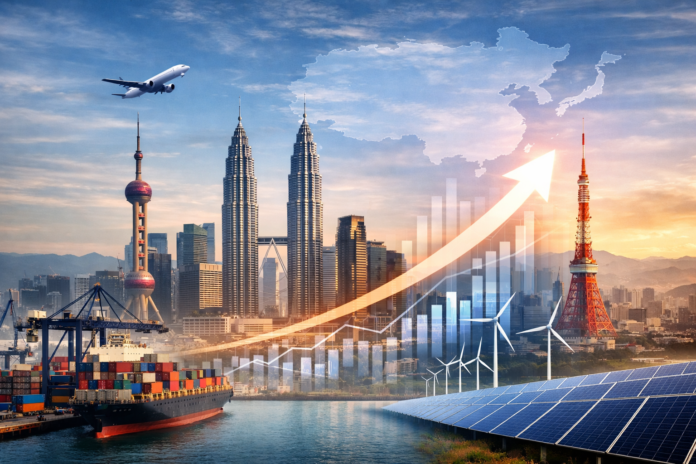
Asia’s economic growth has become one of the defining forces of the 21st-century global economy. Home to more than half of the world’s population and some of its fastest-developing nations, Asia continues to reshape trade flows, investment patterns, technological innovation, and geopolitical power.
Yet, while Asia’s growth story is compelling, it is far from simple. Alongside rapid expansion come structural risks, inequality, environmental pressure, and political uncertainty. Understanding Asia’s economic growth—its opportunities and challenges—is essential for investors, policymakers, businesses, and global institutions alike.
This article explores the key drivers fueling Asia’s rise, the opportunities it presents, and the critical obstacles that could shape its future trajectory.
The Drivers Behind Asia’s Economic Growth
Demographic Strength and Urban Expansion
Asia’s population advantage remains one of its strongest economic foundations. With a young, expanding workforce in countries such as India, Indonesia, Vietnam, and the Philippines, the region benefits from a large labor pool that supports manufacturing, services, and innovation.
Rapid urbanization has also accelerated productivity. Mega-cities across Asia are becoming economic engines, attracting investment, talent, and infrastructure development that boost GDP growth.
Industrialization and Manufacturing Power
Asia has established itself as the global manufacturing hub. China, South Korea, Japan, and Southeast Asian economies dominate supply chains in electronics, automotive, textiles, and heavy industry.
Even as some nations move up the value chain, lower-income Asian countries continue to benefit from labor-intensive manufacturing, creating a natural progression of industrial growth across the region.
Technological Leapfrogging
Unlike earlier industrial economies, many Asian countries have bypassed legacy systems and embraced digital solutions directly. Mobile banking, e-commerce, fintech, and AI adoption are accelerating productivity and financial inclusion.
This ability to leapfrog has allowed Asia to compete globally in sectors such as semiconductors, renewable energy technology, software services, and digital platforms.
Key Opportunities in Asia’s Economic Growth
Expanding Consumer Markets
Rising incomes have created a fast-growing middle class across Asia. This surge in consumer spending presents massive opportunities in retail, healthcare, education, housing, entertainment, and financial services.
Domestic demand is becoming a more powerful growth engine, reducing reliance on exports alone.
Foreign Direct Investment (FDI) and Trade Integration
Asia continues to attract substantial foreign investment due to its growth potential, improving infrastructure, and expanding trade agreements. Regional frameworks and bilateral partnerships strengthen supply chains and improve market access.
For multinational corporations, Asia represents not just a manufacturing base but a strategic end market.
Green Growth and Renewable Energy
Asia is emerging as a critical player in the global energy transition. Investments in solar, wind, electric vehicles, and green infrastructure are creating new industries and jobs while addressing environmental challenges.
Countries that successfully align economic growth with sustainability stand to gain long-term resilience and global leadership.
The Major Challenges Facing Asia’s Economic Growth
Income Inequality and Social Disparities
Despite impressive GDP growth, wealth distribution remains uneven across many Asian economies. Rural-urban divides, wage gaps, and unequal access to education and healthcare risk slowing long-term growth by limiting human capital development.
Inclusive growth remains one of Asia’s most pressing challenges.
Environmental Pressure and Climate Risk
Rapid industrialization has come at a high environmental cost. Air pollution, water scarcity, deforestation, and climate vulnerability threaten both public health and economic stability.
Extreme weather events and rising sea levels pose serious risks to agriculture, infrastructure, and densely populated coastal cities.
Geopolitical and Trade Uncertainty
Asia’s economic future is closely tied to global trade, making it vulnerable to protectionism, supply-chain disruptions, and geopolitical tensions.
Strategic rivalries, shifting alliances, and regulatory fragmentation create uncertainty for investors and businesses operating across borders.
Aging Populations in Advanced Asian Economies
While some Asian countries benefit from young demographics, others—such as Japan, South Korea, and parts of China—face aging populations and shrinking workforces.
These demographic shifts increase pressure on public finances, healthcare systems, and long-term productivity growth.
How Asia Can Balance Growth and Stability
To sustain momentum, Asian economies must focus on structural reforms that improve productivity, governance, and resilience. Key priorities include:
- Investing in education and skill development
- Strengthening social safety nets
- Promoting sustainable urban planning
- Encouraging innovation and entrepreneurship
- Enhancing regional cooperation
Countries that successfully adapt their growth models will be better positioned to navigate global uncertainty.
The Global Impact of Asia’s Economic Growth
Asia’s rise is not occurring in isolation. Its economic expansion influences global inflation, commodity markets, technology development, and international investment flows.
As Asia grows, it increasingly shapes global economic governance, trade standards, and innovation ecosystems. The region’s success—or setbacks—will have far-reaching consequences for the world economy.
Conclusion: A Defining Economic Era
Asia’s economic growth represents both immense opportunity and significant challenge. The region’s ability to harness its demographic strengths, technological capabilities, and entrepreneurial energy—while addressing inequality, environmental risk, and geopolitical complexity—will determine its long-term success.
For the global economy, Asia is no longer just an emerging force. It is a central pillar of future growth, innovation, and transformation.
Understanding Asia’s Economic Growth: Opportunities and Challenges is not optional—it is essential for anyone looking to grasp the direction of the world economy.