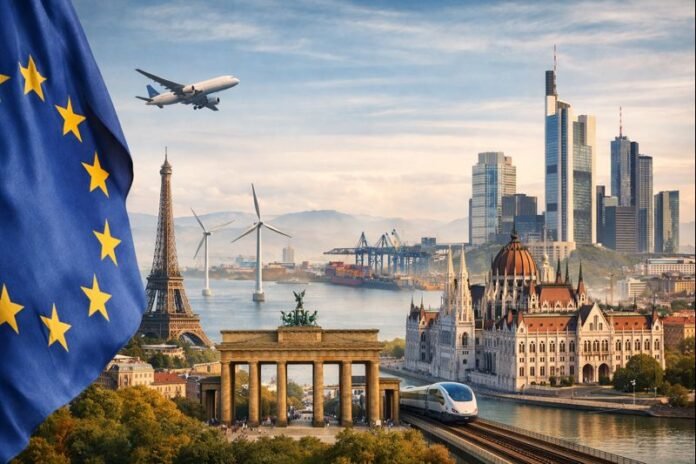
Europe is standing at a pivotal crossroads. Once viewed as a stable political and economic bloc with deeply rooted cultural traditions, the continent is now navigating rapid transformation driven by global power shifts, financial uncertainty, technological change, and evolving social values. Understanding Europe in a changing world requires looking closely at how politics, the economy, and culture are reshaping one another—and what this means for Europe’s future role on the global stage.
Political Transformation Across Europe
European politics has undergone significant change over the past decade. Traditional party systems are being challenged by new movements that reflect voter frustration, shifting identities, and concerns about sovereignty.
The Rise of Populism and Political Polarization
Populist parties have gained traction in several European countries, fueled by debates around immigration, globalization, and national identity. While some movements emphasize economic protectionism, others focus on cultural preservation or skepticism toward supranational institutions like the European Union.
This political polarization has made governance more complex, often leading to fragile coalitions and frequent elections. At the same time, it has forced mainstream parties to rethink their platforms and reconnect with voters who feel left behind by globalization.
Europe’s Role in Global Geopolitics
Europe’s geopolitical position is also evolving. Relationships with powerful nations like the US, China, and Russia have grown increasingly strategic and occasionally tense. The focus of political discourse has shifted to topics like foreign policy coordination, energy security, and defense spending.
The European Union continues to seek a balance between deeper integration and respect for national sovereignty, especially in foreign policy and security matters.
Economic Shifts and Challenges
The European economy is experiencing structural change, shaped by technological innovation, demographic shifts, and global competition.
Economic Recovery and Inequality
While many European economies have shown resilience, economic recovery has been uneven. Some regions benefit from strong industrial bases and innovation hubs, while others struggle with unemployment and declining industries. This imbalance has widened economic inequality both within and between countries.
Governments are increasingly focused on inclusive growth—investing in skills, education, and infrastructure to ensure that economic progress reaches all segments of society.
Green Transition and Digital Innovation
In terms of sustainability, Europe has established itself as a global leader. Ambitious climate goals are driving investment in renewable energy, green technology, and sustainable industries. While the shift to a low-carbon economy is opening up new possibilities, existing sectors must also make considerable adjustments.
At the same time, digital transformation is reshaping European businesses. Artificial intelligence, automation, and remote work are redefining productivity and employment, forcing policymakers to modernize labor laws and social protection systems.
Cultural Evolution in a Diverse Europe
Culture remains one of Europe’s greatest strengths, yet it is also changing rapidly in response to migration, technology, and generational shifts.
Migration and Multicultural Identity
Migration has transformed Europe’s cultural landscape, enriching societies with new perspectives, languages, and traditions. However, it has also sparked debates about integration, social cohesion, and national identity.
Younger generations tend to embrace multiculturalism more openly, while older populations may view rapid change with concern. Bridging this cultural divide has become a central challenge for European societies.
Technology and Changing Social Values
Digital platforms have reshaped how Europeans communicate, consume culture, and engage politically. Social media influences public opinion, activism, and even election outcomes, while streaming services and online content are redefining cultural expression.
Social ideals are changing concurrently. Concerns like mental health awareness, LGBTQ+ rights, and gender equality are becoming more well-known, which is indicative of a larger movement in most of Europe toward social justice and inclusivity.
The Future of Europe in a Changing World
Europe’s future will depend on its ability to adapt without losing the values that define it. Cooperation between nations, smart economic reform, and cultural openness will be essential in navigating uncertainty.
If Europe succeeds, it can remain a powerful global actor—one that combines democratic governance, economic innovation, and cultural diversity. If it fails to adapt, internal divisions may weaken its influence on the world stage.
Conclusion
Europe in a changing world is a story of transformation, resilience, and challenge. Political realignment, economic modernization, and cultural evolution are reshaping the continent in profound ways. By addressing inequality, embracing innovation, and fostering unity amid diversity, Europe has the opportunity to redefine its place in the 21st century—not just as a region of the past, but as a leader of the future.