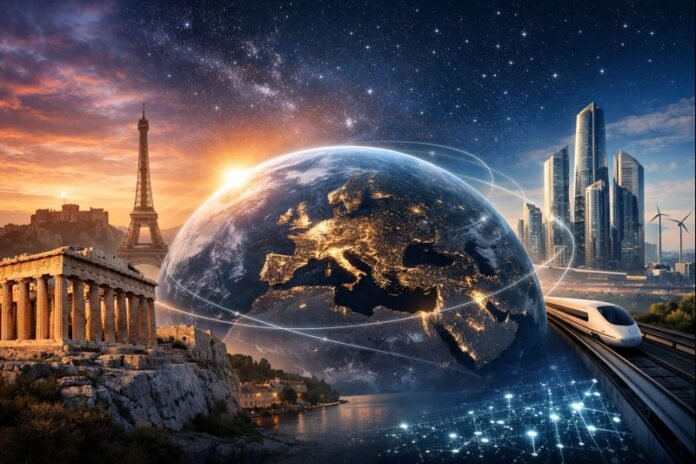
Europe’s role in shaping global history and the future is impossible to overlook. From ancient civilizations and transformative empires to revolutionary ideas that reshaped politics, science, and culture, Europe has been a central force in defining how the modern world came to be. Yet Europe’s influence is not limited to the past. In a time of social progress, Europe still has a significant impact on the future, digital transformation, geopolitical realignment, and climate change.
Understanding Europe’s global impact requires looking beyond simple timelines. It demands an exploration of ideas, institutions, and values—many of which originated in Europe and now influence societies worldwide.
The Foundations: Europe’s Early Impact on Civilization
Long before Europe became a global power center, its early civilizations laid intellectual and cultural foundations that continue to shape humanity.
Classical Greece and Rome
Ancient Greece introduced concepts that remain fundamental today: democracy, philosophy, scientific inquiry, and artistic expression. Thinkers like Plato, Aristotle, and Socrates laid the groundwork for logic, ethics, and political theory.
Rome expanded on Greek ideas while contributing its own enduring legacies—legal systems, infrastructure, governance models, and administrative efficiency. Modern legal frameworks across continents still echo Roman law, highlighting Europe’s early and lasting influence on global governance.
Europe and the Making of the Modern World
The Renaissance: A Rebirth of Knowledge
The European Renaissance marked a turning point in human history. It revived classical learning, encouraged artistic mastery, and placed human reason at the center of intellectual life. This period sparked advances in science, literature, architecture, and education that rippled far beyond Europe’s borders.
The Age of Exploration and Global Exchange
Europe’s maritime expansion connected continents in unprecedented ways. While the Age of Exploration led to trade, cultural exchange, and technological diffusion, it also brought colonization and exploitation—realities that still shape global inequalities today.
Acknowledging both achievements and consequences is essential when evaluating Europe’s role in global history. This balanced perspective is increasingly important as Europe engages in dialogue about restitution, reconciliation, and historical accountability.
Ideas That Changed the World
The Enlightenment and Political Transformation
European Enlightenment thinkers challenged absolute power and promoted liberty, equality, and human rights. These ideas inspired revolutions in America, France, and beyond, forming the philosophical backbone of modern democratic systems.
Concepts such as freedom of speech, secular governance, and the rule of law—now considered universal ideals—emerged largely from European intellectual movements.
Industrialization and Economic Change
Europe’s Industrial Revolution transformed economies worldwide. Advances in manufacturing, transportation, and energy reshaped how societies worked and lived. While industrialization brought growth and innovation, it also introduced challenges such as environmental degradation and labor exploitation—issues the world continues to confront today.
Europe’s Role in Shaping the Contemporary Global Order
Architect of International Cooperation
In the aftermath of devastating world wars, Europe helped pioneer new models of international cooperation. Institutions promoting diplomacy, economic integration, and peace emerged with strong European involvement.
The European Union itself stands as a unique experiment—demonstrating how former rivals can integrate economically and politically to reduce conflict and promote shared prosperity.
Champion of Human Rights and Soft Power
Europe wields significant influence through soft power rather than military dominance. Its emphasis on human rights, diplomacy, cultural exchange, and development aid shapes global norms and international dialogue.
European standards in areas like data protection, environmental policy, and consumer rights often become global benchmarks, influencing legislation far beyond the continent.
Europe and the Future of the World
Europe’s role in shaping global history and the future is evolving. Rather than dominating through empire or expansion, Europe increasingly influences the world through innovation, ethics, and collaboration.
Climate Leadership and Sustainability
Europe continues to have a big impact on the future in an era of societal advancement. Through ambitious environmental policies, renewable energy investment, and sustainability frameworks, it is helping set the agenda for a greener future. As climate challenges intensify, Europe’s leadership in this area may prove one of its most significant historical contributions.
Technology, Ethics, and Digital Governance
As artificial intelligence, biotechnology, and digital surveillance reshape society, Europe is pushing for ethical frameworks that prioritize human dignity and privacy. Its approach to technology governance may influence how the digital future unfolds globally.
A Multipolar World
In a world no longer dominated by a single superpower, Europe acts as a stabilizing force—bridging East and West, North and South. Its capacity to manage trade, diplomacy, and cultural variety places it in a crucial position to influence the balance of the world.
Challenges Europe Must Confront
Europe’s future influence is not guaranteed. Internal political divisions, economic inequality, demographic shifts, and external pressures test its unity and global relevance. How Europe responds to migration, technological disruption, and geopolitical competition will shape not only its own future, but the international order as well.
Conclusion: A Living Legacy
Europe’s role in shaping global history and the future is not a closed chapter—it is an ongoing story. From ancient philosophy to modern diplomacy, Europe has continually redefined its place in the world. Its greatest impact may now lie not in power or conquest, but in ideas, cooperation, and responsibility.
As the world faces unprecedented challenges, Europe’s historical experience—marked by conflict, reflection, and renewal—offers valuable lessons. Whether Europe can transform those lessons into meaningful global leadership will determine how its legacy continues to shape the future.