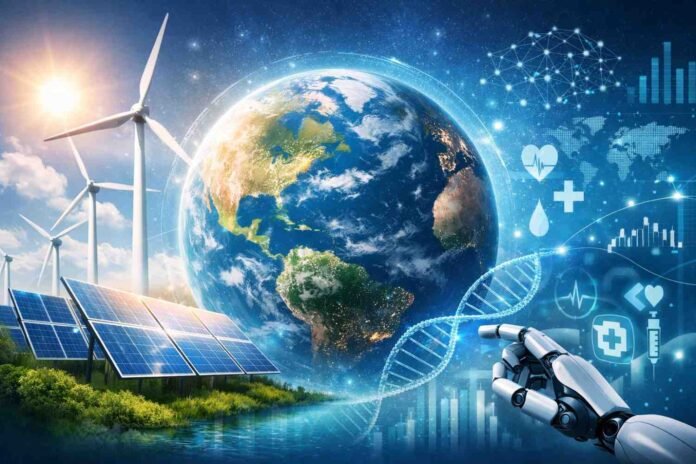
The world today faces challenges that are complex, interconnected, and global in scale. Climate change, pandemics, food insecurity, poverty, and energy shortages affect billions of lives. While these problems may seem overwhelming, science and technology are playing a decisive role in creating practical, scalable solutions.
From artificial intelligence predicting disease outbreaks to renewable energy transforming how we power our cities, innovation is no longer optional—it is essential. This article examines how science and technology are changing the future by finding practical, quantifiable solutions to global issues rather than just theoretical ones.
The Power of Science and Technology in a Globalized World
Scientific research helps us understand problems at their root, while technology turns that understanding into action. Together, they form a powerful engine for progress.
Unlike traditional solutions that often work in isolation, modern scientific and technological approaches are:
- Data-driven
- Scalable across borders
- Adaptable to local needs
- Faster to deploy than ever before
This combination allows governments, organizations, and communities to respond to crises with precision and speed.
Fighting Climate Change Through Clean Energy and Innovation
Climate change is one of the most urgent global threats, but science and technology are helping slow its impact.
Renewable Energy Solutions
Fossil fuel use is decreasing thanks to developments in solar, wind, and hydroelectric power. Clean energy is becoming more dependable and economical because of smart grids, better battery storage, and energy-efficient buildings.
Climate Monitoring and Prediction
Satellite technology and climate modeling tools allow scientists to track rising sea levels, melting glaciers, and extreme weather patterns. This data helps policymakers make informed decisions and prepare vulnerable regions before disasters strike.
Carbon Capture and Green Materials
Innovations in carbon capture technology and biodegradable materials are reducing industrial emissions and environmental waste, paving the way for a more sustainable economy.
Improving Global Healthcare With Science and Technology
Healthcare inequalities have long plagued developing and underserved regions. Today, technology is narrowing that gap.
Disease Detection and Prevention
Artificial intelligence and data analytics can identify disease outbreaks early by analyzing patterns in health data. This has proven especially valuable in managing infectious diseases and preventing global pandemics.
Telemedicine and Digital Health
Remote consultations, wearable devices, and mobile health apps allow people in rural or low-resource areas to access medical care without traveling long distances.
Biotechnology and Medical Research
Breakthroughs in genetics, vaccines, and personalized medicine are improving treatment outcomes while reducing costs. Scientific collaboration across borders has accelerated life-saving discoveries at unprecedented speed.
Tackling Food Insecurity With Agricultural Technology
A significant issue is feeding the world’s expanding population, but science and technology are revolutionizing agriculture.
Precision Farming
Using sensors, drones, and AI-driven analytics, farmers can monitor soil health, crop growth, and water usage in real time. This reduces waste while increasing yields.
Genetically Improved Crops
Scientific advances have led to crops that are more resistant to pests, droughts, and disease—especially critical in regions affected by climate change.
Sustainable Farming Practices
Technology supports eco-friendly farming methods that protect biodiversity and preserve natural resources for future generations.
Reducing Poverty and Expanding Economic Opportunities
Technology has become a powerful tool for economic inclusion.
Digital Finance and Mobile Banking
With mobile financial platforms, millions of people without access to traditional banks may now establish businesses, receive payments, and save money.
Education Through Technology
Online learning platforms, virtual classrooms, and AI-powered tutoring systems are making quality education accessible worldwide, regardless of geography.
Job Creation Through Innovation
Emerging fields like renewable energy, data science, and robotics are creating new job opportunities and transforming economies.
Addressing Global Water and Sanitation Challenges
Clean water is a basic human need, yet many regions still lack access.
Water Purification Technologies
Scientific advancements in filtration, desalination, and water recycling are providing safe drinking water to communities facing scarcity.
Smart Water Management
IoT-enabled sensors detect leaks, monitor water quality, and optimize distribution, helping cities conserve resources and reduce costs.
Artificial Intelligence’s Potential to Address Global Issues
Artificial intelligence is becoming a central force in problem-solving across sectors.
- Predicting natural disasters
- Optimizing supply chains during humanitarian crises
- Enhancing medical diagnostics
- Supporting scientific research through faster data analysis
When used responsibly, AI amplifies human intelligence and accelerates solutions to global challenges.
Ethical Innovation and Responsible Technology Use
While science and technology offer immense benefits, responsible use is essential. Ethical frameworks, transparent governance, and inclusive design ensure that innovation benefits everyone—not just a few.
Global collaboration between scientists, governments, and communities is key to balancing progress with responsibility.
The Future: A World Shaped by Scientific Solutions
The question is no longer whether science and technology can solve global problems—but how quickly we can scale these solutions.
Humanity has a once-in-a-lifetime chance to create a more sustainable, fair, and healthy world as research funding increases and technology becomes more widely available.
Science provides the knowledge. Technology delivers the tools. Together, they are shaping solutions that once seemed impossible.
Final Thoughts
How science and technology are solving global problems is not just a topic—it’s an ongoing story of innovation, resilience, and hope. By continuing to support research, embrace innovation, and apply solutions ethically, we can turn today’s challenges into tomorrow’s breakthroughs.