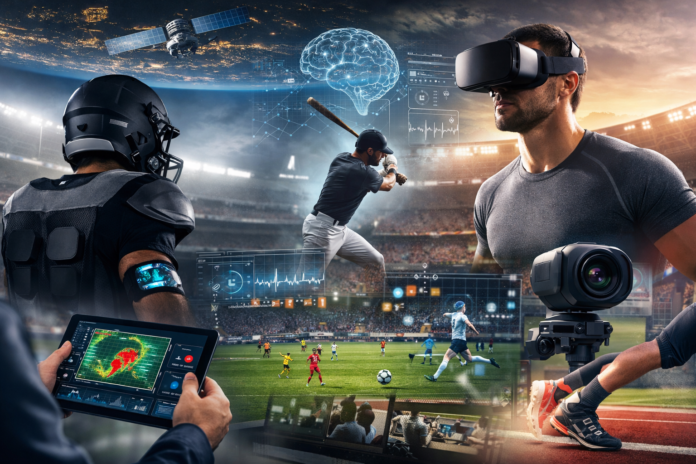
Technology is no longer a supporting player in professional sports—it’s shaping the game itself. From data-driven coaching decisions to immersive fan experiences, modern innovations are redefining how athletes train, how teams compete, and how audiences engage with sports worldwide.
As leagues invest heavily in digital transformation, the competitive edge increasingly belongs to those who embrace technology the fastest and smartest. Here’s an in-depth look at how technology is transforming professional sports and why its impact is only accelerating.
Data Analytics’ Ascent in Competitive Sports
Data analytics has become one of the most powerful tools in professional sports. Every movement, sprint, shot, and pass can now be measured and analyzed.
Performance Optimization
Teams use advanced analytics to track player workload and fatigue, identify performance patterns, and optimize game strategies in real time. Sports like basketball, soccer, and baseball rely heavily on predictive analytics to make decisions that were once based purely on instinct.
Smarter Recruitment and Scouting
Data models help teams evaluate talent more accurately by analyzing player efficiency metrics, injury history, and long-term performance trends. This reduces risk and improves return on investment when signing athletes.
Wearable Technology and Athlete Health
Wearable devices have revolutionized training and injury prevention.
Real-Time Monitoring
Athletes now wear GPS trackers, heart-rate monitors, and motion sensors that provide insights into speed, acceleration, muscle strain, and recovery rates. Coaches can adjust training loads instantly, preventing overuse injuries.
Injury Prevention and Recovery
Technology helps medical staff detect early warning signs of injury, allowing athletes to recover faster and extend their careers.
Artificial Intelligence in Sports Strategy
Artificial intelligence is changing how teams analyze opponents and make tactical decisions.
Game Strategy and Simulation
AI systems can simulate thousands of game scenarios, predict opponent behavior, and recommend strategic adjustments mid-game. This gives teams a strategic advantage that was unimaginable just a decade ago.
Officiating and Fair Play
AI-powered video review systems help referees make more accurate calls, reducing human error and increasing fairness.
Virtual Reality and Augmented Reality Training
VR and AR technologies are redefining how athletes prepare for competition.
Immersive Training Environments
Quarterbacks can practice reading defenses, and race car drivers can memorize tracks without stepping onto the field or track.
Mental Conditioning
VR helps athletes improve reaction time, build confidence, and prepare mentally for high-pressure moments where performance matters most.
Technology Enhancing the Fan Experience
Technology doesn’t just benefit athletes—it’s transforming how fans experience sports.
Immersive Viewing Experiences
Fans now enjoy 360-degree replays, augmented reality stats during broadcasts, and multiple camera angles on demand.
Digital Engagement
Fans can engage with clubs and players in real time through social media, mobile apps, and fantasy sports platforms, forging stronger emotional bonds.
Smart Stadiums and the Future of Live Events
Modern stadiums are becoming high-tech entertainment hubs.
Connected Infrastructure
Smart stadiums feature high-speed Wi-Fi, mobile ticketing, cashless payments, and personalized fan experiences.
Sustainability and Efficiency
Technology also helps reduce energy consumption and improve crowd management, making events safer and more environmentally responsible.
Biomechanics and Advanced Sports Science
Sports science has reached new levels of precision.
Movement Analysis
High-speed cameras and motion-capture systems analyze biomechanics to improve running form, throwing mechanics, and jump efficiency.
Extending Athletic Longevity
By understanding how the body moves and recovers, teams can extend careers and maximize peak performance years.
The Future of Professional Sports Technology
The next wave of innovation includes fully AI-driven coaching assistants, advanced neurotraining tools, and hyper-personalized fan content. As technology continues to evolve, professional sports will become faster, safer, and more data-driven than ever before.
Final Thoughts
Technology is transforming professional sports at every level—from athlete development and coaching strategies to fan engagement and stadium design. What was once considered futuristic is now essential.
Teams that embrace innovation get a quantifiable competitive edge, while those that don’t run the danger of falling behind. The future of professional sports is undeniably powered by technology.