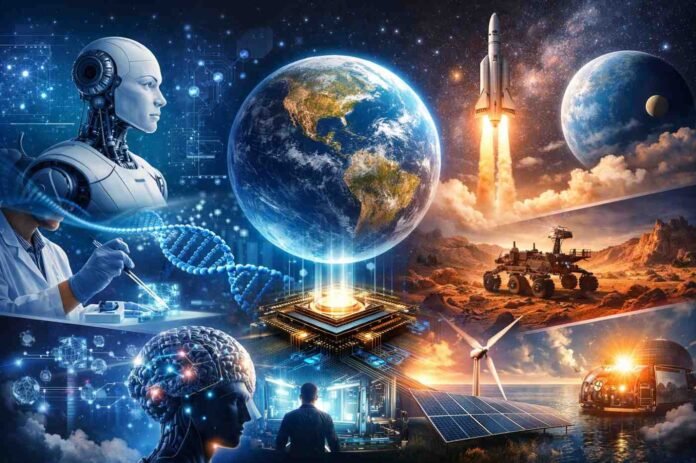
Science rarely changes the world in a single dramatic moment. Instead, progress arrives quietly—through lab experiments, unexpected data patterns, and ideas that slowly reshape how we live, work, and think. Yet today, we are witnessing a convergence of discoveries so powerful that their combined impact may redefine the future faster than any era before.
From medicine and artificial intelligence to climate science and space exploration, the latest scientific discoveries changing our future are not theoretical concepts anymore. They are already moving out of research labs and into daily life.
Let’s explore the breakthroughs that are setting the direction for the decades ahead.
1. Artificial Intelligence Is Learning to Think More Like Humans
Recent advances in artificial intelligence have gone far beyond automation. Scientists are now developing AI systems that can reason, adapt, and learn contextually—closer to human cognition than ever before.
Why This Matters
- AI models can now analyze massive datasets in healthcare, climate research, and physics within seconds.
- Self-learning systems are improving decision-making in medical diagnostics and scientific simulations.
- AI-assisted research is accelerating discoveries that once took decades.
These systems increasingly serve as collaborators, assisting scientists in testing theories, identifying anomalies, and spotting patterns that are imperceptible to the human eye, rather than taking the place of people.
2. Gene Editing Is Entering a New Era
CRISPR technology revolutionized biology, but the latest discoveries have made gene editing more precise, safer, and ethically controllable.
Recent Breakthroughs Include:
- Editing genes without cutting DNA, reducing unintended mutations
- Treating inherited diseases at the cellular level
- Correcting genetic disorders before symptoms appear
This marks a turning point in medicine. Instead of treating symptoms, science is learning how to eliminate disease at its source, potentially extending healthy human lifespan and quality of life.
3. Quantum Computing Is Moving From Theory to Reality
Quantum computing was once considered purely experimental. Today, scientists are successfully stabilizing qubits and reducing error rates—two of the biggest barriers to real-world use.
Future Impacts:
- Solving complex chemical simulations for drug development
- Revolutionizing encryption and cybersecurity
- Optimizing global supply chains and energy systems
Once scaled, quantum computers could outperform classical computers in ways that fundamentally alter science, economics, and national security.
4. Clean Energy Breakthroughs Are Redefining Sustainability
One of humanity’s biggest problems is still climate change, but science is offering real promise.
Key Discoveries Changing Energy Production:
- Perovskite solar cells with dramatically higher efficiency
- Nuclear fusion experiments are achieving net energy gain.
- Advanced battery technologies capable of long-term energy storage
These innovations make a carbon-neutral future increasingly realistic, shifting sustainability from aspiration to achievable goal.
5. Neuroscience Is Unlocking the Mysteries of the Human Brain
Understanding consciousness and cognition has long been one of science’s greatest puzzles. Recent discoveries are bringing clarity.
Researchers can now:
- Map neural circuits with unprecedented accuracy
- Restore movement through brain-computer interfaces.
- Decode how memories form and fade.
These findings are already transforming treatments for paralysis, Alzheimer’s disease, depression, and PTSD—offering renewed hope to millions.
6. Space Science Is Expanding Our Understanding of Life
The search for life beyond Earth has intensified. New data from space telescopes and planetary missions have revealed organic molecules and potentially habitable environments far beyond our planet.
Why This Is Revolutionary:
- Scientists are discovering water-rich exoplanets.
- Mars samples suggest ancient biological potential.
- Space-based observatories can analyze alien atmospheres.
These discoveries are not just about space—they challenge how we define life itself and humanity’s place in the universe.
7. Material Science Is Creating the Impossible
From self-healing materials to ultra-light metals stronger than steel, material science is enabling innovations that once belonged to science fiction.
Applications Already Emerging:
- Medical implants that adapt to the body
- Buildings that respond to environmental stress
- Electronics that bend, stretch, and repair themselves
These materials will reshape manufacturing, architecture, and consumer technology over the next decade.
How These Discoveries Interconnect
What makes the latest scientific discoveries changing our future so powerful is not their individual impact—but how they reinforce one another.
AI accelerates genetic research.
Quantum computing enhances climate modeling.
Material science enables better energy storage.
Science is no longer advancing in isolated fields. It’s evolving as a connected ecosystem.
What the Future Holds
We are entering an age where:
- Diseases are prevented, not treated.
- Energy becomes abundant and clean.
- Human intelligence is augmented, not replaced.
- Exploration extends beyond Earth.
The future shaped by these discoveries will demand ethical responsibility, global cooperation, and thoughtful leadership—but the tools to build a better world are already here.
Final Thoughts
The latest scientific discoveries changing our future are not distant possibilities. They are unfolding now, influencing healthcare, technology, sustainability, and human potential in real time.
History will likely look back on this period as a turning point—when curiosity, data, and innovation converged to redefine what it means to be human.
And the most exciting part?
We’re only at the beginning.