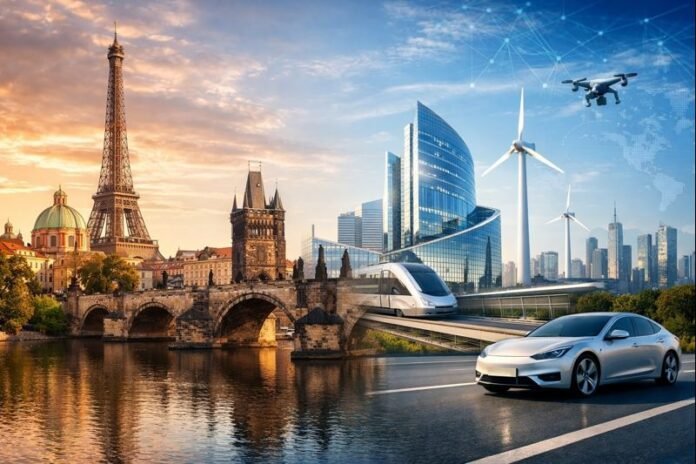
Europe has always been a continent shaped by contrast. Ancient stone streets lead to glass-walled innovation hubs. Centuries-old traditions coexist with cutting-edge technology. In today’s rapidly changing world, modern Europe is defined by its ability to balance tradition and innovation—not as opposing forces, but as complementary pillars of progress.
This delicate balance is what allows Europe to preserve its cultural identity while remaining globally competitive. From architecture and education to business, technology, and social values, Europe’s modern success lies in respecting the past while confidently shaping the future.
Europe’s Deep-Rooted Traditions: A Living Foundation
Tradition in Europe is not frozen in time—it is lived, practiced, and adapted. Cultural heritage remains visible in everyday life, from language and cuisine to festivals, craftsmanship, and urban design.
Historic city centers such as Rome, Prague, and Paris are preserved not as museums, but as functional spaces where people live, work, and socialize. Local markets still operate alongside global retail brands. Family-owned businesses pass skills from one generation to the next, maintaining standards that mass production cannot replicate.
Importantly, European traditions also shape values. Strong social systems, labor protections, and public institutions reflect long-standing beliefs in community responsibility, fairness, and quality of life. These principles continue to influence policymaking and economic models across the continent.
Innovation as a European Necessity, Not a Trend
While tradition forms the backbone of European identity, innovation drives its relevance. Facing global competition, climate challenges, and demographic shifts, Europe has embraced innovation as a strategic imperative.
European cities are increasingly becoming global leaders in:
- Green technology and renewable energy
- Artificial intelligence and robotics
- Sustainable urban planning
- Advanced manufacturing and design
Countries like Germany, Sweden, the Netherlands, and Estonia demonstrate how innovation can thrive within structured systems. Rather than disrupting recklessly, Europe often innovates responsibly—testing, regulating, and refining new ideas before scaling them.
This approach may appear cautious, but it has produced long-term resilience and public trust.
Architecture: Where Past and Future Meet
Few places illustrate modern Europe’s balance between tradition and innovation better than its architecture. Historic preservation laws protect medieval buildings, cathedrals, and cultural landmarks, while contemporary architects design bold structures that redefine skylines.
Examples include:
- Modern glass extensions attached to centuries-old museums
- Eco-friendly buildings integrated into historic districts
- Adaptive reuse of factories and warehouses into creative spaces
This architectural dialogue between eras reflects Europe’s broader mindset: innovation should enhance heritage, not erase it.
Business and Industry: Innovation with Identity
European businesses often differentiate themselves by blending innovation with tradition. Luxury fashion houses use digital tools while maintaining artisanal craftsmanship. Automotive companies invest heavily in electric mobility while drawing on decades of engineering excellence.
Small and medium-sized enterprises (SMEs)—a cornerstone of the European economy—are especially adept at this balance. Many combine traditional expertise with modern technologies such as automation, e-commerce, and data analytics, allowing them to remain competitive without losing their character.
This model proves that innovation does not require abandoning identity—it can strengthen it.
Education and Research: Tradition-Driven Excellence
Europe’s oldest universities continue to rank among the world’s best, not despite their age, but because they evolve. Institutions founded hundreds of years ago now lead research in medicine, climate science, engineering, and digital ethics.
European education emphasizes:
- Critical thinking over rote learning
- Interdisciplinary research
- Collaboration between academia, industry, and government
This system produces graduates who respect historical knowledge while pushing intellectual boundaries—an essential combination for sustainable innovation.
Technology with Ethics at the Core
One defining feature of modern European innovation is its ethical framework. Data protection laws, environmental standards, and consumer rights regulations reflect a belief that progress should serve people, not exploit them.
Rather than prioritizing speed alone, Europe often asks deeper questions:
- How does technology affect privacy and democracy?
- Can innovation reduce inequality instead of increasing it?
- Is economic growth compatible with environmental responsibility?
This value-driven approach positions Europe as a global leader in responsible innovation, particularly in areas like AI governance and sustainability.
Cultural Evolution Without Cultural Loss
European culture continues to evolve through immigration, digital media, and global exchange. Music, art, and literature draw inspiration from diverse influences, creating new forms of expression while honoring traditional roots.
What makes Europe unique is not resistance to change, but its ability to absorb change thoughtfully. New cultural layers are added rather than replacing existing ones, creating societies that are dynamic yet grounded.
The Future of Modern Europe
As Europe looks ahead, the challenge is not choosing between tradition and innovation, but strengthening the relationship between them. Climate change, technological disruption, and geopolitical uncertainty demand creative solutions—yet Europe’s greatest advantage remains its historical depth.
By learning from the past while designing the future, Europe demonstrates that progress does not require forgetting where it came from.
Modern Europe’s success lies in balance—a balance that turns history into a guide, not a constraint, and innovation into a tool for preservation as much as transformation.
Final Thoughts
Modern Europe: Balancing Tradition and Innovation is more than a concept—it is a lived reality shaping cities, industries, and everyday life. This balance allows Europe to remain culturally rich, socially stable, and economically forward-looking in an increasingly complex world.
In an age of rapid change, Europe offers a powerful lesson: the future is strongest when it is built on a foundation that respects the past.