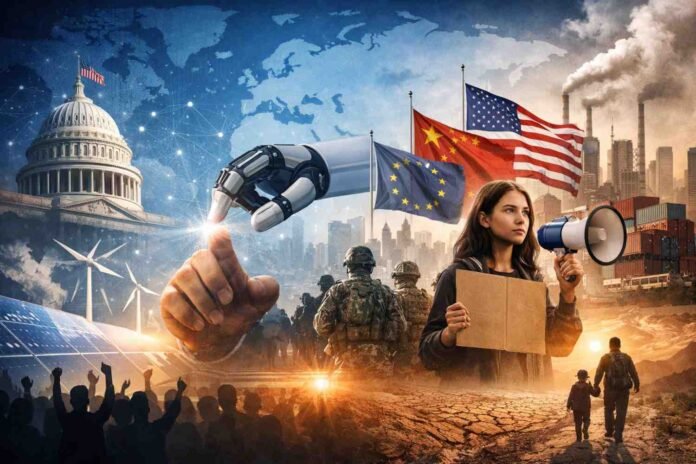
Politics across the world is entering a period of accelerated change. Technological disruption, shifting demographics, climate pressure, and evolving public expectations are reshaping how power is exercised and challenged. Understanding these political trends is no longer optional—it is essential for governments, businesses, and citizens alike.
Below are the most important political trends that will shape the future, based on observable global shifts and emerging policy directions.
The Rise of Digital Governance and AI in Politics
Governments are increasingly turning to digital tools to improve efficiency, transparency, and decision-making. Artificial intelligence is already being used to detect fraud, analyze voter behavior, and optimize public services.
However, this trend comes with serious political consequences. Questions around algorithmic bias, surveillance, and data ownership are pushing policymakers to define new regulatory frameworks. Countries that balance innovation with ethical governance will likely gain political legitimacy, while those that misuse digital power may face public backlash.
In the future, political debates will focus less on whether governments should use AI and more on how it should be controlled.
Growing Political Polarization and Fragmentation
One of the most visible political trends shaping the future is deepening polarization. Across democracies, ideological divides are widening, often fueled by social media, economic inequality, and identity politics.
This fragmentation weakens traditional political parties and creates space for populist movements, single-issue political groups, and outsider candidates who challenge institutional norms. As compromise becomes politically risky, governance may grow more unstable. Countries that fail to reform political institutions to encourage cooperation could face prolonged legislative gridlock.
Youth-Led Political Movements and Generational Power Shifts
Young voters are no longer a passive political group. They are shaping policy agendas around climate action, social justice, and digital rights. With Millennials and Gen Z becoming the largest voting blocs in many countries, political priorities are shifting rapidly.
This generational transition is forcing governments to rethink education policy, employment structures, housing affordability, and environmental regulation. Political leaders who ignore youth-driven demands risk long-term irrelevance, while those who integrate them may redefine future governance models.
Climate Politics Becoming Central, Not Peripheral
Climate change is no longer a niche political issue. It is reshaping national security strategies, economic planning, and international relations. Climate-driven migration is influencing border policies, the green industrial strategy is reshaping trade alliances, and climate litigation is increasingly targeting governments and corporations.
As environmental risks intensify, climate policy will increasingly determine electoral outcomes, especially in regions vulnerable to extreme weather and resource scarcity.
Decline of Traditional Global Power Structures
A single superpower will not dominate the future of global politics. Instead, a multipolar world is emerging, where regional powers wield greater influence.
This shift is visible in new trade alliances outside traditional Western frameworks, strategic competition over technology and energy, and increased geopolitical tension across Asia, Africa, and the Middle East. As global institutions struggle to adapt, countries are pursuing flexible partnerships rather than fixed ideological blocs.
Nationalism Coexisting With Global Interdependence
While globalization once suggested a borderless political future, nationalism is resurging. Governments are prioritizing domestic industries, national security, and cultural identity.
At the same time, global interdependence remains unavoidable, particularly in supply chains, climate cooperation, and public health. Managing national interests without undermining international collaboration will be one of the defining political challenges of the future.
Increased Demand for Political Transparency and Accountability
Citizens are demanding more from their leaders—not just promises, but measurable outcomes. Access to information, whistleblower protections, and independent journalism are becoming central political battlegrounds.
Governments that embrace transparency may rebuild public trust, while those that resist scrutiny may face growing civil unrest. Political legitimacy in the future will depend as much on openness as on authority.
Redefinition of Democracy and Governance Models
One of the most profound political trends shaping the future is the redefinition of democracy itself. From digital voting experiments to citizen assemblies and decentralized governance, traditional democratic systems are being tested and reimagined.
Some countries may strengthen democratic participation through reform, while others may drift toward hybrid or authoritarian models under the guise of efficiency or stability. The global political landscape will not converge—it will diversify.
Final Thoughts
The political trends that will shape the future are interconnected, fast-moving, and deeply consequential. Technology, climate pressure, generational change, and shifting power dynamics are redefining how politics functions at every level.
Those who understand these forces early—whether policymakers, businesses, or engaged citizens—will be better positioned to adapt, influence, and lead in an uncertain political future.