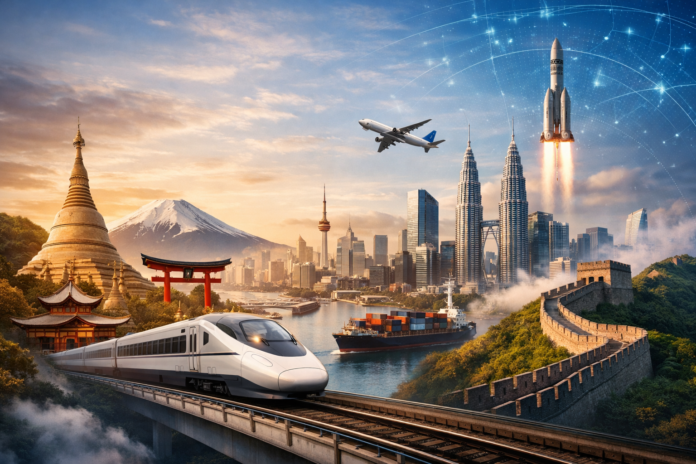
Asia is undergoing one of the most profound transformations in human history. Home to more than half of the world’s population, the continent has emerged as a driving force behind global economic growth, technological innovation, cultural influence, and geopolitical change. The dynamic transformation of Asia in the modern era is not a single story but a mosaic of interconnected shifts—economic, social, political, and cultural—that continue to reshape the global order.
From bustling megacities and digital economies to evolving social identities and regional power realignments, Asia’s modern evolution reflects both deep historical roots and rapid adaptation to contemporary challenges.
Historical Foundations of Asia’s Modern Transformation
To understand Asia’s current trajectory, it is essential to recognize its historical context. Colonialism, imperial legacies, and post-war reconstruction shaped much of Asia’s political and economic frameworks throughout the 19th and 20th centuries.
After World War II, many Asian nations emerged from colonial rule with fragile institutions but strong ambitions. Countries such as India, Indonesia, and Vietnam pursued nation-building paths grounded in self-determination, while others like Japan and South Korea focused on industrial rebuilding with global integration.
These foundations laid the groundwork for the modern transformation that accelerated toward the end of the 20th century.
Economic Power Shifts Across Asia
One of the most visible elements of the dynamic transformation of Asia in the modern era is its economic rise.
From Manufacturing Hub to Innovation Engine
Asia’s early growth was fueled by manufacturing and export-led development. Japan pioneered this model in the post-war period, followed by the “Asian Tigers” — South Korea, Taiwan, Hong Kong, and Singapore.
Today, the region has moved far beyond low-cost production:
- China has evolved into a global leader in e-commerce, fintech, renewable energy, and artificial intelligence.
- India has become a major force in software services, startups, and digital infrastructure.
- Southeast Asia is emerging as one of the fastest-growing digital consumer markets in the world.
Asia now contributes a substantial share of global GDP growth, signaling a long-term structural shift rather than a temporary surge.
Rapid Urbanization and Infrastructure Development
Modern Asia is increasingly urban. Cities such as Shanghai, Seoul, Jakarta, Mumbai, and Bangkok have grown into megacities that serve as economic and cultural hubs.
Smart Cities and Connectivity
Governments across Asia have invested heavily in infrastructure:
- High-speed rail networks in China and Japan
- Smart city initiatives in Singapore and South Korea
- Digital public infrastructure in India
These investments have transformed mobility, commerce, and access to services, fundamentally changing how millions of people live and work.
However, rapid urbanization has also brought challenges—housing affordability, congestion, and environmental strain—forcing policymakers to rethink sustainable development models.
Technological Transformation and Digital Society
Technology is at the heart of Asia’s modern evolution.
Mobile-First and Digital-Native Populations
Asia is home to some of the world’s most digitally connected populations. Mobile technology has leapfrogged traditional infrastructure, especially in emerging economies.
Key developments include:
- Cashless payment ecosystems in China and Southeast Asia
- Digital identity and governance platforms in India
- World-leading semiconductor and electronics industries in East Asia
This digital transformation has empowered entrepreneurs, expanded financial inclusion, and reshaped social interaction across borders.
Cultural Evolution in a Globalized Asia
Despite rapid modernization, Asia has not lost its cultural depth. Instead, tradition and modernity often coexist in unique ways.
Global Influence of Asian Culture
Asian culture now has unprecedented global reach:
- Korean music, television, and fashion dominate international media.
- Japanese design, cuisine, and pop culture continue to influence global trends.
- Indian cinema, yoga, and literature reach worldwide audiences.
Rather than cultural homogenization, Asia’s transformation has amplified regional identities on a global stage.
Shifting Social Dynamics and Demographics
The dynamic transformation of Asia in the modern era is also deeply social.
Youth, Aging, and Changing Lifestyles
Asia faces contrasting demographic realities:
- Countries like India, Indonesia, and the Philippines have youthful populations driving workforce growth.
- Japan, South Korea, and China confront aging societies and declining birth rates.
At the same time, education levels are rising, gender roles are evolving, and middle classes are expanding—reshaping consumption patterns, family structures, and political expectations.
Political Transformation and Regional Influence
Asia’s political landscape is increasingly influential on global affairs.
Regional Cooperation and Strategic Competition
Organizations such as ASEAN, regional trade agreements, and diplomatic forums reflect Asia’s growing role in shaping global governance. Meanwhile, strategic competition among major powers has placed Asia at the center of geopolitical discussions.
Many Asian countries now pursue more assertive foreign policies, balancing national interests with regional stability in a multipolar world.
Environmental Challenges and Sustainable Futures
Economic growth has come at a cost. Pollution, climate vulnerability, and resource pressures are major concerns across Asia.
Green Transitions and Innovation
In response, Asian nations are investing in:
- Renewable energy and electric mobility
- Climate-resilient agriculture
- Sustainable urban planning
Asia’s ability to balance growth with sustainability will play a critical role in determining the planet’s future.
What the Future Holds for Asia
The dynamic transformation of Asia in the modern era is far from complete. The continent stands at a crossroads—poised between unprecedented opportunity and complex challenges.
Key trends shaping Asia’s future include:
- Continued technological leadership
- Greater regional integration
- Rising global cultural influence
- Intensifying focus on sustainability and inclusion
Rather than following a single model, Asia’s transformation reflects diverse paths shaped by history, culture, and innovation.
Final Thoughts
Asia’s modern transformation is not merely a regional story—it is a global one. As economic power, cultural creativity, and technological innovation increasingly shift eastward, understanding Asia’s evolution is essential for anyone seeking insight into the 21st century.
The dynamic transformation of Asia in the modern era reveals a continent that is not only adapting to change but actively shaping the future of the world.